
WVU Researchers Examine Economic Impacts of Aquatic Dead Zones
Güncelleme tarihi: 26 Tem
This article informs about the pollution in coastal ecosystems such as the Gulf of Mexico, Lake Erie, and the Chesapeake Bay due to the negative effects of agricultural production. As a result of nitrogen fertilizer runoff, marine life in many areas are harmed turning those areas into “dead zones”. Using the key concept of externalities, this commentary will analyze how agricultural runoff leads to market failure and what policies could successfully address the issue. In economics, a negative externality of production, for this example, occurs when the marginal social cost (MSC) of producing a good exceeds the marginal private cost (MPC). In the case in this news article the nitrogen fertilizer used in farming activities gets into the downstream systems and increases excess nutrients in there. As a result of excess nutrients, algal blooms are formed in the water. These blooms form negative externality because they take up the oxygen in water as they decompose, reducing the oxygen amount in water, causing marine life to lose balance and die.
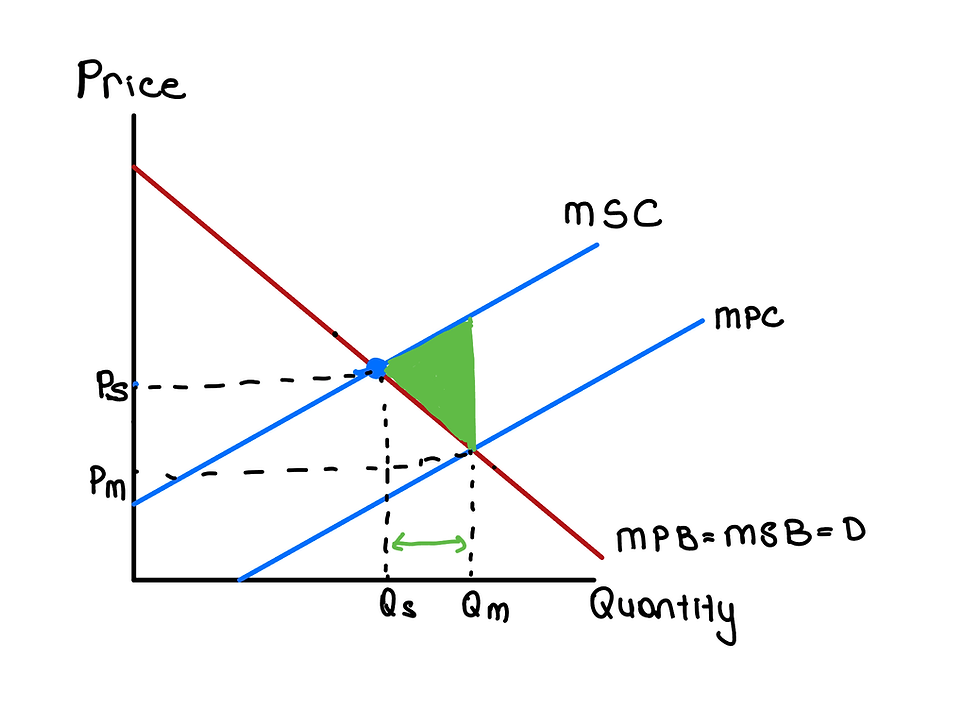
The market equilibrium (Qm,Pm) occurs where marginal private benefit equals marginal private cost , MPB = MPC, but the socially optimal level of output (Qs) is lower, where MSC = MPB. The green area between MSC and MPC for units between Qs and Qm represents deadweight loss —a loss of allocative efficiency and total welfare. This deadweight loss reflects not only ecological damage, but also the economic losses to industries dependent on clean water, such as fishing, manufacturing, and tourism.
According to the article, WVU researchers could estimate the amount of nitrogen reaching the Gulf of Mexico/America, Lake Erie and the Chesapeake Bay. EPA studies found that nitrogen runoff to the Gulf needs to be reduced by about 45% to meet the intended goals, which is around 7 billion dollars. Despite the setted reducing goals for dead zones, not much progress has been made over the past few years. The reduction of nitrogen usage has both positive and negative drawbacks. But before that, a progress towards the aim should be made.
To correct this market failure, government intervention is necessary. One commonly proposed solution is a Pigouvian tax on fertilizer usage. As shown in the diagram below, taxing fertilizer internalizes the external cost by shifting the MPC curve leftwards, moving it closer to the MSC.

As seen in the graph above taxation propels producers to pay full social cost of the good, since production is now harder with the tax burden, the private supply curve, meaning MPC will shift left and get closer to the MSC curve. Though such government intervention decreases welfare loss and moves the equilibrium towards the socially optimal point, the effect on other markets related to farming would not be as economically rational.
However, such a policy comes with trade-offs. A fertilizer tax would likely increase the cost of staple crops like corn and soybeans, potentially raising food prices and burdening consumers. Additionally, farmers may experience decreased profits, especially small-scale producers who cannot easily switch to more sustainable practices. These trade-offs raise questions of efficiency in environmental policy designs.
To cancel out these concerns new policies must complement or alternate the taxation imposed. For example subsidies for environmentally friendly technologies, such as natural agriculture or organic fertilizers, could encourage farmers to adopt cleaner methods voluntarily. Additionally, the government must bring new education programs and technical assistance for farmers to improve awareness and capacity to apply sustainable practices
Ultimately, this case exemplifies how markets could fail to allocate resources efficiently in the presence of externalities. When decision makers, producers, are not bearing the full cost of their actions, negative externalities, environmental harm, would occur. This pushes the government to bring new pricing mechanisms and regulations to both sides of the market. However as such in the example these laws must be carefully balanced in order to protect the previously optimal producing markets.


Citation
“WVU Today | WVU Researchers Examine Economic Impacts of Aquatic Dead Zones.” Wvu.edu, 30 Jan. 2025, wvutoday.wvu.edu/stories/2025/01/30/wvu-researchers-examine-economic-impacts-of-aquatic-d ead-zones.



Yorumlar